




















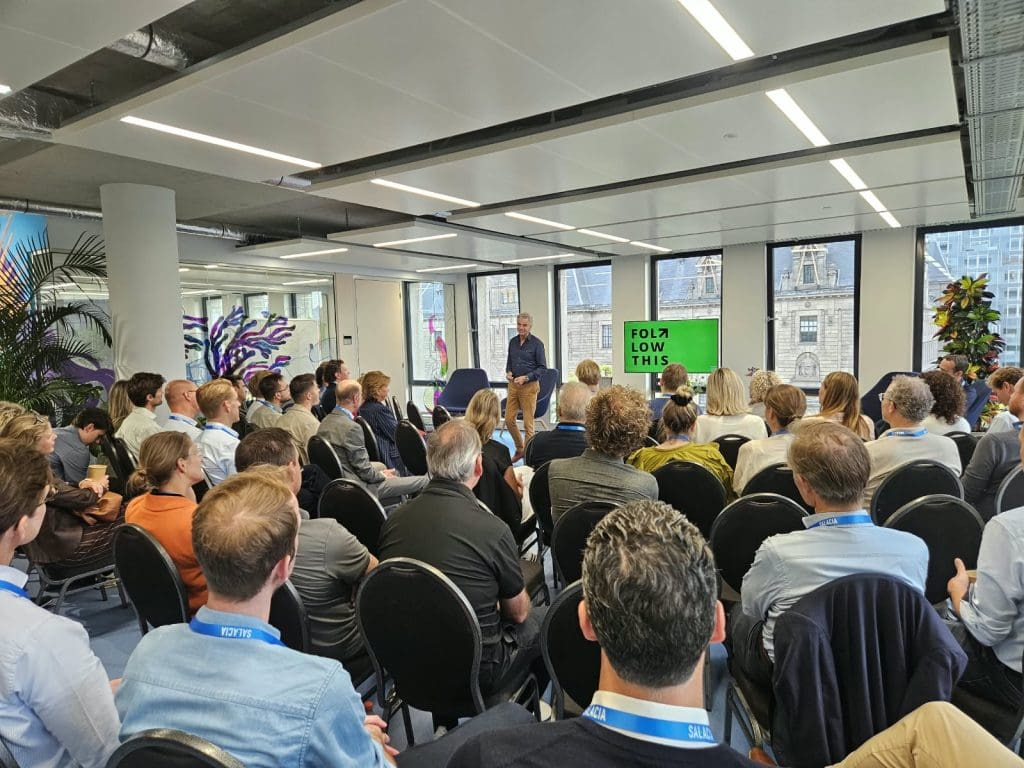


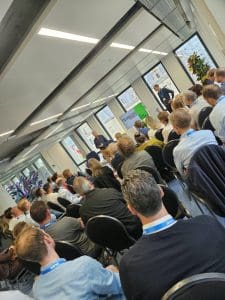
Yesterday morning, September 8, 2026, Salacia Solutions opened its doors on the Coolsingel in Rotterdam for the second edition of the Change Makers Breakfast. Between 08:00 and 10:00, leaders, entrepreneurs, and changemakers gathered for a breakfast with a special guest: Mark van Baal, founder and CEO of Follow This.
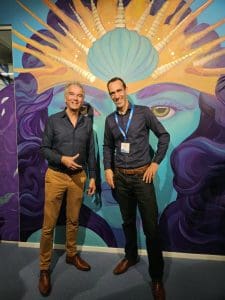
From Ben Cohen to Mark
Kees opened the morning with a brief look back at how this series came about. The very first Change Makers Breakfast, with Ben Cohen (co-founder of Ben & Jerry’s) as guest, was received so positively and enthusiastically that the decision to turn it into a recurring event followed quickly. Mark van Baal, then, isn’t just a second guest, he’s the second in a series that continues on a regular basis from here on.
The path to Mark ran, unsurprisingly, through Ben and his network, a nice example in itself of how small the world of changemakers really is.
An uncomfortable confession to start
Mark opened his own story with striking honesty. As a mechanical engineering student in Delft in the late 1980s, he went through a rough hazing ritual with his student association. He promised himself two things back then: that he’d see it through, and that he would one day change the initiation once he had a say. Years later, he became vice-chair of that very hazing committee – and changed nothing…
He shared this deliberately with a room full of changemakers, as an illustration of how difficult change from within really is: newcomers to an organization often think they’ll do things differently once they’re in charge, but first have to accept the status quo for years before they’re in a position to change anything. Follow This came about as a way to force change from the outside as a shareholder, not as an employee.
From journalist to shareholder activist
Mark originally trained as a mechanical engineer, worked in business for a while, and after turning 30 decided to do something more creative and meaningful: journalism. The turning point came in 2006, after watching Al Gore’s An Inconvenient Truth. As an engineer, he immediately understood: the technology (solar panels, wind turbines, batteries) already existed, and was getting cheaper by the day. The earth receives enough solar energy within an hour to power the entire global economy for a year. The problem wasn’t technological, it was that fossil fuel companies were doing anything with it.
For years, Mark tried as a journalist to convince Shell through well-researched articles: why the energy transition would be good for the world and for the company itself, warning that otherwise they’d become “the Kodak of the 21st century.” It didn’t work, journalists mostly talk to spokespeople, not to the people who actually matter. Companies don’t listen to journalists, he discovered, nor to governments or protesters. They listen to their shareholders.
“Wouldn’t it be great if…”
Mark outlined how, in his view, every major change starts with someone thinking: wouldn’t it be great if… Lucy Stone wondering whether women shouldn’t be allowed to vote. Rosa Parks refusing to give up her seat. For Mark, the question was: wouldn’t it be great if oil companies put their full weight behind the energy transition? That question, he said, is exactly what it’s about: it’s not about saving the climate for its own sake, but about making companies realize there’s an actual business model behind it so that Shell doesn’t become the Kodak of the future.
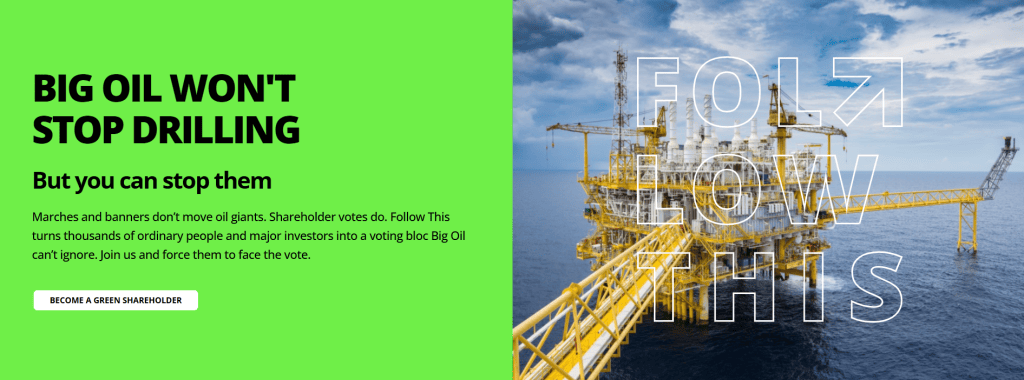
In 2015, he decided to try it himself. With no background in finance or shareholder activism, he founded Follow This and became a shareholder himself, starting with Shell. For 30 euros, people could become “green shareholders”; Mark bought a share on their behalf and spoke at the shareholder meeting representing hundreds of supporters at once. Shell’s initial responses were friendly indifference: thanks for your sympathetic initiative, please come back next year.
A key source of inspiration was a well-known TED talk: How to Start a Movement by Derek Sivers, about a man dancing alone in a field at a festival. Only once the first follower joins in – daring to participate before it feels safe – does a lone eccentric with a strange idea turn into a movement. Sivers’ core lesson: it’s not the leader who makes the difference, but the first followers who show others how to join in.

Mark translated that into three concrete lessons he passed on to the room: you have to be visible, you have to be willing to make a fool of yourself, and you have to actively look for your first followers and celebrate them the moment they join.
Visibility also turned out to be the literal key to funding: filing an official shareholder resolution required around 5 million euros in shares at the time. It was only because Mark stayed visible and consistently went to the press that he eventually found a major investor willing to buy a million euros’ worth of Shell shares – enough to file the first official shareholder resolution in 2016.
From 2.7% to a majority: how more followers led to more power
What followed was years of perseverance, and a self-reinforcing mechanism: the more green shareholders joined, the more shares Follow This could buy on their behalf in Shell and the other major players and the more weight behind the vote at the shareholder meeting. In the first year (2016), the resolution got 2.7% of the vote negligible at first glance, but a signal, given that normally 99.9% of shareholders follow management. The year after, that doubled to 6.3%. Shell felt pressured enough to promise emissions targets for the first time (a halving by 2050) too late and too little, in Follow This’s view, but the first time an oil company took responsibility for scope 3 emissions (the emissions of its customers, not just the company itself).
Every year the votes rose, the companies’ targets shifted along with them: first 2050, then 2030. The same pattern repeated at BP, Equinor, Chevron, Phillips 66, and Occidental Petroleum. In 2021, a majority voted in favor for the first time in the US, helped in part by the oil price collapsing during the COVID crisis, forcing companies to rethink their business models anyway. At a certain point, a company like that simply couldn’t ignore the vote anymore.
Behind those numbers, according to Mark, are mostly “unsung heroes” within pension funds: people who look conservative, wear the same suits and pearl necklaces as their colleagues, and certainly don’t look like activists, but who behind the scenes convince their organization to vote in favor, sometimes at the risk of a “passive-aggressive” phone call from Shell to their boss once the voting became public. They simply want to be on the right side of history, and push companies toward new business models. That, in Mark’s words, makes them the real heroes of this story.
Meanwhile, media recognition grew too. Where Follow This was initially dismissed as “a sympathetic initiative,” outlets including the Financial Times and The Guardian later wrote that the organization had become a serious counter-voice to the oil industry with real influence, not just a sympathetic voice.
The line between engaging and selling
A recurring theme in the Q&A was the difference between engagement (staying a shareholder and applying pressure) and divestment (selling shares). Mark is outspokenly critical of the latter: pension funds that, after years of support, decide to sell their shares because they’ve “lost faith” are taking the easy way out. The shares then end up with less responsible owners, and the problem doesn’t disappear – it just disappears from view. His point: you sell tobacco shares, and the company doesn’t vanish; the same happens with oil and gas companies. Follow This wants large institutional investors to stay on board, precisely because voting power is the only leverage that forces a company to change.
Pushback from an unexpected corner
2021 felt like a turning point: majorities in the US, a sense that the climate movement was winning. After that, Mark said, Follow This also faced serious pushback from the oil industry itself – including a legal action from ExxonMobil, filed in early 2024 and later concluded. Mark explicitly cited this as proof that the organization had gained enough influence to no longer be ignored: a small organization of ten people provoking that kind of response from one of the world’s largest companies is clearly doing something that matters.
Dealing with pushback
Mark also spoke candidly about how he personally deals with criticism and doubt from people around him. Sometimes it’s easier to simply ignore disagreement than to have every conversation out – friends who know he won’t join a far-flung trip don’t need a back-and-forth about it. He also shared how, right before starting in 2015, he consulted dozens of people about his idea, only to learn years later that one of them had told him at the time that it was a bad plan, but Mark had simply chosen to ignore it.
Toward other climate organizations with different tactics, Mark is notably generous: he made a point of never arguing about tactics as long as the goal is shared. Extinction Rebellion blocks roads, Milieudefensie files lawsuits and those lawsuits against Shell even turned out to be an indirect weapon for Follow This, since court rulings against Shell served as arguments to pension funds to vote in favor of climate resolutions. The one exception is the “fossil free” divestment movement, which he’s critical of, for the reasons above.
Staying convinced it’s solvable
Asked whether he’s still optimistic, Mark was firm: he has to be, otherwise he wouldn’t keep going himself. His conviction remains that the climate crisis is a problem we can solve- not one we should resign ourselves to. Follow This now counts around 4,000 green shareholders, supplemented by philanthropic support, and keeps looking for new angles: asking companies not just for emissions targets, but to concretely show how they’ll stay profitable once demand for oil and gas declines – something the International Energy Agency considers inevitable.
Everyone can make a difference
Mark closed his story with a message aimed directly at the room: everyone can make a difference. Think back to your own wouldn’t it be great if…, be visible, and celebrate your first followers. His call to the changemakers in the audience: stand up in your own company and be the lone nut – or, if that feels more daunting, be someone else’s first follower who’s already out there dancing.
Asked what he considered the single most important ingredient for success, Mark was clear: if one of the major oil companies genuinely changes course and shows that the green path is also profitable, the others will follow.
Why this matters
The most lasting insight from this morning: change rarely starts with institutions. It starts with individuals who dare to challenge existing norms and keep going until others join and who are willing to be visible, even if that means being ridiculed before the first followers show up. Mark’s story, together with Ben Cohen’s during the first edition, lays the foundation of the Change Makers Breakfast series: not a stage for famous entrepreneurs, but a platform for people who turn conviction into action.
Want to become part of the movement Mark started? Follow This is accessible from €30 a year via action.follow-this.org.