





















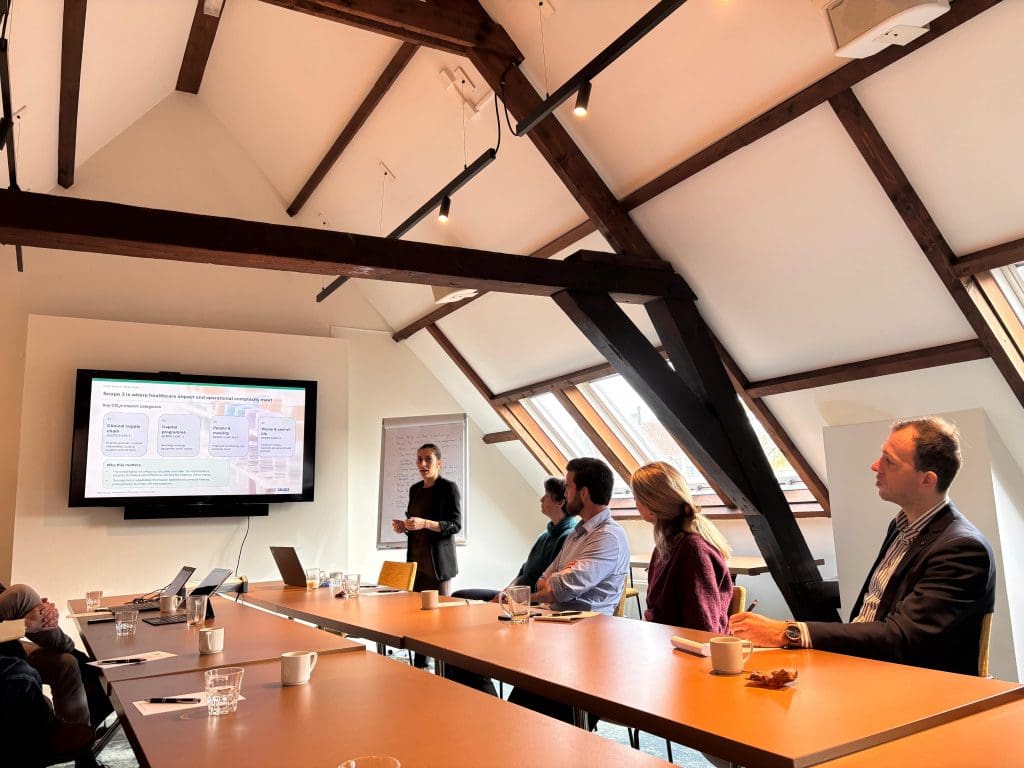
On 29 October 2026, sustainability, procurement, finance and operations professionals from Dutch hospitals came together in Utrecht. Together with our partner BDO, we hosted a roundtable on one question: how does a hospital really get a grip on its Scope 3 emissions?
The setting was special. In an attic room at Hotel Karel V, we had an open and in-depth conversation. No sales pitch, but hospitals sharing honestly what they run into and what they have already figured out.
The Green Deal doesn’t mention Scope 3, but can’t do without it
We started with the Green Deal Sustainable Healthcare, which has recently been signed again. Its concrete CO2 target focuses on buildings, energy and transport: 55% lower emissions by 2030 compared to 2018. It says little explicitly about Scope 3.
Yet the conclusion at the table was clear. The commitments on circularity, procurement and medicines reach deep into a hospital’s supply chain. Think of 50% less primary raw-material use by 2030 and climate-neutral, circular healthcare by 2050. Anyone who wants to meet those goals cannot avoid a solid Scope 3 calculation. That is where most of the impact sits.
Scope 3 reporting is still far behind
BDO shared the results of its Healthcare Sustainability Benchmark. It assesses the public reporting of 59 general hospitals against 14 indicators, from energy and waste to absenteeism and waiting lists.
The picture: hospitals are reporting more and more, but Scope 3 clearly lags behind. Only 22% of general hospitals publish Scope 3 figures, up just 1.7 percentage points. By comparison, 93% report on energy and 88% on waste. Among the university medical centres (UMCs), the share publishing Scope 3 is considerably higher at 57%.
An important caveat: the benchmark measures whether information is public, not how well a hospital performs. But what you don’t measure and share is hard to manage.
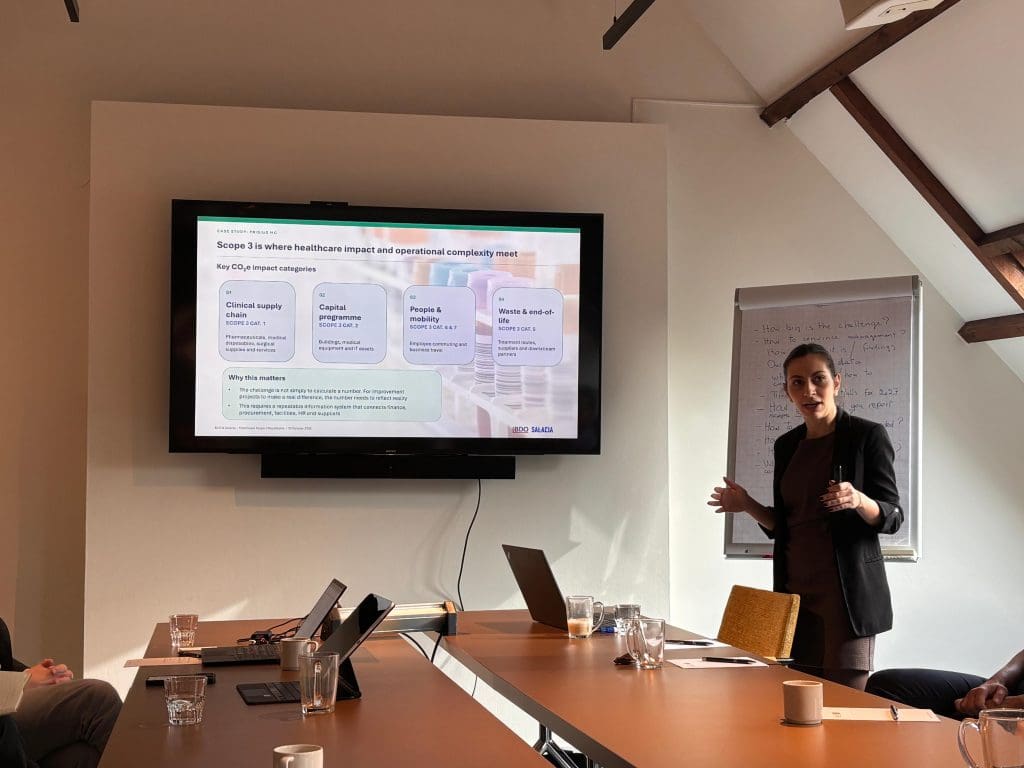
Frisius MC case: start with the big picture, then zoom in
Next, we presented the case we carried out with BDO at Frisius MC over the past year. The core of the approach: don’t start with perfection, start with completeness.
Step one is a broad, spend-based calculation across the whole hospital. It showed total Scope 3 emissions of 165,177 tonnes CO2e for 2025. Purchased goods and services accounted for 71%, capital goods for 22%. Pharmaceuticals and medical products stood out as the biggest hotspots.
Step two is to zoom in on those hotspots. There, you move to activity-based data: actual quantities, materials and product-specific factors. And that is where you see how large the differences can be. For medical equipment and disposables, calculated emissions fell from 30,732 to 17,329 tonnes CO2e. Across all refinements, the total footprint came out about 9% lower, at 149,613 tonnes CO2e.
Just as important: the picture of where emissions sit shifted. On a spend basis, expensive low-volume products such as ICDs and heart valves look like the main culprits. On an activity basis, low-cost, high-volume products come to the surface instead, such as cover materials, gauze and osteosynthesis products. Those are exactly the products procurement can actually influence.
Our message: begin with an overall picture, then zoom in further round by round. That way you get a sharper view every year, and you only invest in extra precision where it changes a decision.

Different routes, one direction

The most valuable part of the morning was the conversation with the hospitals at the table. They openly shared their bottlenecks: who owns Scope 3, which data are hardest to obtain, and how do you keep an annual update feasible with limited capacity?
What stood out was how different the routes were. Erasmus MC, Amsterdam UMC and Frisius MC each chose their own approach. Amsterdam UMC, for example, started bottom-up, with detailed product-level analyses for selected categories. Frisius MC opted instead for a complete, top-down baseline.
As the discussion went on, the positions moved closer together. Erasmus MC will follow the same method as Frisius MC. Amsterdam UMC also moved towards this approach. The shared lesson: be complete first, then go deeper where it matters. The two routes also turn out to complement each other well, with in-depth product analyses as the next step on the hotspots.
What can hospitals do now?
We closed with concrete steps every hospital can take:
- Within 30 days: form a cross-functional Scope 3 group and agree what the analysis is for.
- Within 90 days: map the available data, set the boundaries and complete a first hotspot screening.
- Next reporting cycle: build a repeatable baseline and improve one or two hotspots that can change a decision.
- At sector level: use networks such as NVZ and Milieu Platform Zorg to align methods, data requests and supplier expectations.
Other sectors show this works. Construction has a single shared source of environmental profiles in the Nationale Milieudatabase. In dairy, around 16,000 farmers calculate with the same method and factors. A shared approach in healthcare could greatly speed up the move from averages to specific data.
We thank all participants for their openness and BDO for the great collaboration.
Want to talk further about your hospital’s Scope 3 approach?