
























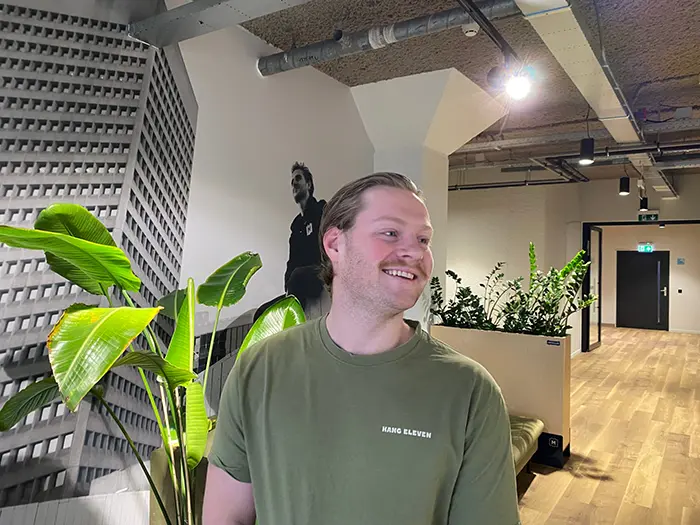
For Joor Slabbers, just 22 years old and born and raised in The Hague, a new world has opened up in Rotterdam. He is doing an internship at Salacia Solutions as part of his Master’s in Financial Economics at Erasmus University. Joor: “Doing an internship at Salacia Solutions is a whole different ball game. The assignment I have here is really different from the average internship.” Joor is going to make sure Salacia’s software is accessible to SMEs.
The road to Salacia Solutions
Before applying for an internship, Joor had already searched for a suitable position through other channels, but nothing quite matched what he had in mind. “Until I spoke to my girlfriend’s mother, who is very familiar with Salacia Solutions. She sensed that I might be a good fit here. An interview with Kees Kerstens was arranged and two days later we sealed the deal. I have been a member of the team here in Rotterdam since January 13,” says Joor.
He has always been involved in sustainability in a way that everyone is familiar with. ”In your private life, you do what you can to contribute to a better world. However, I had never heard of ESG,” Joor explains. ‘I only really came into contact with it when I came here. It’s nice to be able to contribute to a better world in a professional way with my work for Salacia.”
Why Salacia Solutions’ software is important for SMEs
The CSRD legislation initially applied to listed companies and later to large corporations that are not listed. Salacia Solutions’ software helps set up the mandatory sustainability accounting and makes it easy to do ESG tracking & reporting. A must for these types of companies, but what about small and medium-sized enterprises? Joor explains: “It is not yet mandatory for SMEs to keep sustainability accounts, but if you do manage to do so, it can open up a huge number of opportunities. For starters, it is good for everyone to know what their footprint is when it comes to sustainability. It allows you to prepare for what is inevitably to come. If ESG tracking & reporting is already incorporated into your business structure, there will be no costly and intensive transition later on. However, there are SMEs that are part of a supply chain to large corporations. Consider, for example, manufacturing companies that produce semi-finished products in small series, for the automotive sector or the aviation industry, for example. They will automatically be faced with the question from their customers to demonstrate the impact of their production on the environment, as the CSRD prescribes that large companies must collect data from chain partners. By using software to map everything perfectly, you are ‘compliant’ at the touch of a button.”
Modified version of the software
One of Joor’s tasks is to investigate the minimum requirements that the Salacia software must meet to be useful for SMEs. The package as it is currently available is simply too large, too extensive and in many areas not relevant to SMEs. “And therefore too expensive,” Joor explains. ‘It’s disrespectful to say that we are now working on a ’light version‘ of the software. I see it more as a version that does exactly what it should do. No digital ballast, but ’lean and mean’ and affordable according to SME budgets.” According to Joor, having sustainability accounting within SMEs can have even more advantages that have nothing to do with the supply chain. “Consider, for example, applying for credit. Lenders often look favorably on companies that can provide a decent ESG report. It also indicates that the company is future-oriented and has growth ambitions. And that’s not even mentioning the subsidy schemes that may be available to SMEs if they get serious about ESG.”
Accounting firms as intermediaries
Nothing is as diverse as the large group of SMEs in the Netherlands. How does Salacia plan to reach all those entrepreneurs? Joor has an answer for this too: “Via accounting firms. Most SMEs use the services of an accountancy firm. Together, these firms represent the interests of tens of thousands of SMEs. Moreover, accountants have a perfect understanding of the wishes and requirements of SMEs, so we will consult with them and the rollout of the SME software will naturally also take place via them.”
Together with Joor, we conclude that his internship can be seen as a piece of ‘new business development’. Given his education, it is also a perfect fit for him. We conclude by asking about his plans for the future: “Where do I want to go? I would like to end up in the world of investment banking. ESG is also financially related, so the knowledge I am gaining now is definitely of added value. Hopefully I will end up with employers who, like Salacia Solutions, are horizontally programmed in terms of company structure. That really appeals to me here. I can still enjoy it until May 1, when my internship will officially be over.”